
Deep Drawing / Deep Draw is the process of forming a part from metal sheet stock, commonly referred to as a blank, around a punch as it is drawn through a die. The edges of the metal blank are restrained by a “blank holder” or a sleeve in the case of a redraw.
Since the state of the art does not allow us to go as deep as we might need to go in one draw operation we can institute a redraw, whereby we reduce the diameter and increase the height of a previously drawn shell.
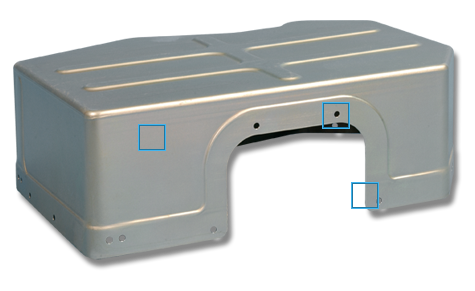
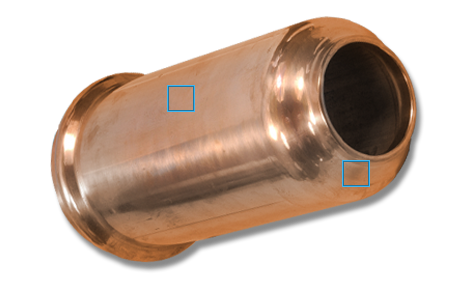
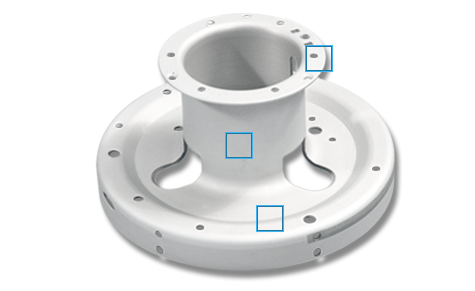
There are many shapes that can be made through deep drawing / deep draw such as cups, pans, cylinde rs, domes & hemispheres, as well as irregular shaped products.
The terms Hydroform / Hydroforming and Deep Draw / Deep Drawing are many times used interchangeably, with Hydroform / Hydroforming now being the industry "buzz word" for metal forming. Both process offer their own unique advantages to metal forming. The following are some design considerations (criteria) that are taken into account when determining the process to be used for a specific part.
Deep Draw / Deep Drawing & Hydroform / Hydroforming Considerations
- Common shapes for Hydroform / Hydroforming parts are domes and concave/convex/dished surfaces, whereas Deep Drawn / Deep Draw shapes are more commonly cans, boxes, and bottles, as well as irregular shaped
products.
- Hydroforming / Hydroform can attain up to a 60% reduction on a metal blank, where Deep Drawing / Deep Draw only a 43% reduction. However, multiple draws are not possible on a hydroform / Hydroforming part, whereas numerous re-draws can be performed on a deep drawn part to attain a desired depth.
- Tooling for a Hydroform / Hydroforming part is typically less expensive than for a Deep Drawn / Deep Drawing part, since only a punch and ring are require
d. Deep Drawing / Deep Draw requires a punch, die and blank holder. If the part is conducive to hydroforming and relatively small quantities are desired, hydroforming / Hydroform provides a cost effective solution to forming the part.
|